August 2006

126 Dimes Capturing the Wild Edible Art In Praise of Roundabouts Leased Paradise Lobster on the Rocks Painting Maine: The Three Wyeths Selling the Maine Experience Soapbox Derby, Uninsured Drivers Soaring to New Heights Swimming With Bear

Selling the Maine Experience

Business: Ecotourism


Ecotourism is creating more buzz than the Maine blackfly in economic development circles. And entrepreneurs and organizations in Maine's rural nirvanas are hoping to lure these "new tourists" their way.
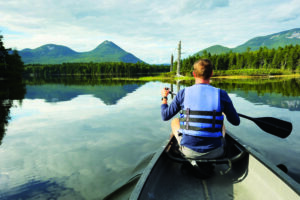
Standing on the beach at Twin Pine Camps on the shores of Millinocket Lake, Matt Polstein sweeps his arm from his chest, showcasing the view. Wind churns the dark lake under a cloudy sky. But Mount Katahdin shimmers in the sun, rising out of the water.

“It’s one of the most appealing visual settings in the state of Maine,” says Polstein, who owns the New England Outdoor Center and River Drivers Restaurant. “Even compared to the coast. It’s a similar feeling to what the coast would inspire, but it’s more dramatic, looking at that mountain, covered with snow.”

In December, Polstein and his wife, Wendy, bought 1,450 acres, including the formerly leased parcel where Twin Pine Camps sits, from Katahdin Timberlands, LLC. The Polsteins intend to build a $50 million resort here, designed to draw what they and others see as a growing market of mostly well-heeled tourists who seek adventure in the Maine woods by day, upscale meals and a comfy bed by night
. The resort plans include 60 to 80 hotel rooms, 20 stand-alone resort homes, and seven “family compounds,” plus a white-tablecloth restaurant, surrounded by walking trails and low-impact access to the lake.

Such a resort, Matt hopes, would lead to economic benefits in an area long stung by population and job losses, a declining pulp and paper industry, and distance from population centers, according to the 44-year-old entrepreneur.

“This is an amazing place, a place people want to come to,” Polstein says. “The variations, from mountains like Katahdin to rivers like the West Branch [of the Penobscot River], to these lakes: It’s a draw. A resource. But the people who want to come here want nice amenities—lodging, restaurants, good service, retail. We’re trying to provide that.”

The plan is to open the resort as soon as the spring of 2008, as a sustainable, low-impact facility offering unique lodging and activities that conserve the area’s character and its resources by being green (he’s looking into sustainable energy, such as solar, wind, or wood power, hoping to make it the first carbon-neutral resort in the world), by featuring local products and vendors, and by offering educational or interpretive programs.

Polstein’s plan puts him at the forefront of a major tenet of the Baldacci administration’s rural economic development plan. The state Department of Economic and Community Development (DECD) sees the same potential Polstein does, and hopes to diversify Maine’s rural economy through the fastest-growing segment of travelers in Maine’s largest and fastest-growing industry, tourism.

The concept is ecotourism, defined by The International Ecotourism Society as “responsible travel to natural areas that conserves the environment and improves the well-being of local people.” The word is often interchanged with nature-based tourism or, in the DECD’s case, “experiential” tourism, though all have different meanings [see sidebar].

The state’s effort, mapped out in a 2005 DECD-commissioned study by FERMATA, a Texas-based tourism consulting firm, is designed to steer tourists not just to the coast and other popular areas of Maine, but to rural, less-developed areas, especially those hurt by the closure of pulp and paper mills, the depletion of fisheries, and other declines in Maine’s traditional industries. Essentially, it would use Maine’s natural resources as attractions rather than just raw materials.

Proponents claim this could be done without sacrificing traditional use of these lands, including hunting and snowmobiling on the recreational side, and timber-cutting by industrial users. Some have their doubts as to whether that balance can be carved out, and worry that ecotourism could impede the diversification of the wood products industry and the potential attraction of other manufacturing jobs.

The FERMATA premise is this: More and more well-to-do folks are drawn to interpretive, active vacations where they can connect with natural, relatively undeveloped areas. Led by the baby boomer generation, this group of tourists is said to have more disposable income and vacation time than most. But they want amenities with their adventure. Build the amenities, market the natural places, and they will come, followed by economic development.

“We’ve seen other countries and regions target these people, and benefit,” says Jeff Sosnaud, deputy director of DECD. “We don’t feel we’ve reached them as well as we’d like, and we have a blueprint to start doing that.”

The FERMATA study looked at Downeast, the north woods, and the western mountains as potential markets for ecotourism. It identified the resources that would be a draw, and the entrepreneurs who are trying to cultivate this kind of business. Maine has more resources than most, they concluded, but not enough places to stay, eat, and shop. It made a series of recommendations geared toward building out that infrastructure, and linking the sites through designated routes, signage, guidebooks, and marketing efforts.
Governor John Baldacci put together a Maine Nature Tourism Initiative Task Force (Polstein is a member) to fulfill the report’s recommendations, and DECD has been working with local groups in all three regions to do just that.

They hope to have the Maine woods and western mountains itineraries completed by this summer, with guidebooks to follow. Sosnaud admits Washington County is further off, but promises to fund staff to “get out there and work with the community groups in existence.”

“This will be a process that’ll take some time,” he says. “It’s longer term. The state’s not rolling in cash, but we have a plan, and we’re serious about implementing it, and we have a lot of good people who are helping us out.”

In April, the Maine Legislature passed the Pine Tree Recreation Zone Act, establishing the zone as north and east of the Androscoggin River. Under the next round of proposed legislation, both new and existing businesses in the zone can qualify for tax incentives to create or improve qualified properties, potentially pumping new dollars into rural economies hungry to diversify. DECD has several community groups dedicated to finding out what kind of infrastructure is needed and what it would take to get the private sector moving toward building it.

“This is a major focus for us,” Sosnaud says. “We’re going to come back to the legislature in the next session, and come up with a package of loans, grants, and incentives to encourage this kind of development. We’re aiming for small business-people in these areas who want to expand and diversify.”

The state views ecotourism as an enabler not just of jobs and business in the short term, but as a catalyst for long-term economic development. Bring in enough of this new market as tourists, and some will elect to move here, the theory goes. Meanwhile, more young people will stay. Some newcomers will bring their
businesses with them—including those involved in areas of the economy with high-paying, high-benefit jobs, such as manufacturing and wood products—and some young people will start their own companies.
It’s happened before with New Balance, Jackson Labs, and (less successfully) MBNA: Corporate executives have come to Maine as tourists and set up shop here, sometimes in spite of the business climate.
“The amenities tourism brings are the same amenities that are precursors to

business development,” Sosnaud says. “Restaurants. Culture. These things can resonate with young people, who we’re trying to keep here. They can resonate with business owners, who might say, ‘This is a cool place to live. I’m coming up for good, and setting up my company here.’”

The ecotourism push, however, is not without controversy. Ken Anderson is a Millinocket resident, former paper worker, and publisher of the Magic City Morning Star, a four-year-old online newspaper whose contributors and message-board posters have been critical of Polstein for, among other things, his potential conflict of interest as both a private developer and member of several government groups, including the Millinocket Town Council, and the Millinocket Area Growth and Investment Council (MAGIC), a quasi-governmental economic development group Polstein cofounded.

Anderson is concerned that ecotourism will cater only to the elite, offer little for longtime area residents, produce poor jobs that lack security, reduce access to land by the public, and threaten what’s left of the paper industry and other manufacturers, present and future. Behind his worries? He thinks the state is over emphasizing a potentially good thing.

“As the only industry permitted to exist in rural Maine, ecotourism would offer large financial rewards to the few business owners who are permitted to compete,” Anderson says, “but only low-paying, no-benefit, seasonal work for the majority of those who were born and raised in the rural areas of Maine—and perhaps a few trinket-selling jobs for those who are intent upon remaining here.”

Sosnaud and other DECD officials hear these kinds of concerns often. Yet he believes ecotourism can develop without harming the rest of the economy or hampering hunting, fishing, wood products manufacturing, and other traditional land use.

“We’re not saying to these folks, ‘Tourism is the savior,’” Sosnaud says. “That’s not it at all. But we need to have every arrow in the quiver in a state like Maine. We’re looking at other economic development activities, but tourism can be a big part of the  picture.”

Polstein says his resort will create dozens, if not hundreds of jobs, including administrative positions in finance and marketing, management of various operations, and food and beverage positions. Today, he has about 26 year-round employees and 70 seasonal, and he sees a chance to solidify those seasonal positions and add others to the payroll.

“These will not be trinket-selling jobs, at our resort or in the community,” Polstein says. “There will be small-business opportunities. Two-thirds of vacation spending is retail. People go to Acadia, but where do they spend their time and money? In Bar Harbor. What does Bar Harbor have? Retail. Restaurants. Entertainment. Social opportunities. We have the attraction. We don’t have the amenity base, but we have the people who will build it.”

Two such “builders” are Rick and Debbie LeVasseur, who invested in the promise two years ago when they built 5 Lakes Lodge, a luxury bed-and-breakfast six miles west of Millinocket on South Twin Lake. Overlooking Mt. Katahdin, the lodge brings together what more well-heeled travelers are looking for—an authentic Maine outdoor experience by day, and pampering and luxury when they return. While the lodge provides breakfast, the LeVasseurs depend on the surrounding tour guides and restaurants—the Polsteins’ “first-class operation,” as Rick says, among them—to keep their guests fed and happy.

In a sense, 5 Lakes Lodge is a test case for the Polsteins’ larger, proposed facility. The vast majority of the lodge’s guests come to experience the Maine outdoors. According to LeVasseur, more than half of his guests visit Baxter State Park, and about a quarter climb Mt. Katahdin. Half go rafting, canoeing, or kayaking during their stay, 10% go birdwatching, 75% take a non-climbing hike, and 90% search for moose. “We take them for granted, but our visitors are absolutely fascinated by moose.”

They also spend $175–$250 per room on lodging, a far cry from the old days when most visitors were content to camp in a tent and sleep on the ground. They dine at River Drivers and other area restaurants, and look for gifts downtown. They’re not finding everything they want, though: The area needs more shops and restaurants.

“Most of our guests search for places to spend their money in Millinocket,” he says. “Unfortunately, there aren’t enough places that have a real sense of allure or that authentic, local feel to the shop or product line.” He hopes the next wave of Pine Tree Recreational Zone legislation will make it easier both for new businesses to open and for existing businesses to renovate or expand.

 That’s the hope in Greenville, too. While as “remote” as the Katahdin area, the Moosehead Lake region is further along on the infrastructure curve, with more high-end lodging and restaurants, “indigenous” shops, and several moose-watching expeditions. Still, Greenville town manager John Simko says, “More is needed.” Even the hotly-debated Plum Creek land development proposal came about, in part, to accommodate the growing number of experiential tourists. While parts of Plum Creek’s proposal remain controversial, all sides agree that any further development needs to be done without losing the area’s character. Ruth McLaughlin is owner of the luxurious Blair Hill Inn at Moosehead Lake, a hilltop Victorian with views of the lake, fine dining, and well-appointed rooms that rent for $250—$425 a night. While the inn itself offers touches like antique furnishings, featherbeds, locally milled bath products, and thick robes, it sees both luxury properties and rustic venues as essential parts of the Maine package. “We just had a trustee of Outward Bound stay with us last night with his wife,” she says. “From here they are heading to a remote sporting camp for a week in a cabin with no electricity or indoor plumbing. After their week at camp, they are returning for another night of pampering here. We find this blend of roughing it and creature comforts is becoming more and more common.”

Simko sees any further development to accommodate new ecotourism opportunities as essentially an extension, not a reinvention. “Our visitors come here because they want to get away from the typical tourist places,” he says. “They like the rustic, rural nature of this area. They’re torn between sharing this place with others and keeping it their little secret.”

Locals, too, are torn by the same dilemma: How to market the area without turning it into Disneyworld with moose. For outdoor sports enthusiasts, the lure of new monies for ecotourism infrastructure also comes with a fear: Will it lead to a reduction in traditional access? Hunting and other “consumptive” uses of rural areas—and snowmobiling and ATVing, which sit somewhere between consumptive and not—aren’t usually included in the list of eco-friendly activities. Some proponents of those activities fear the nature-based push might eventually mean new access restrictions.

George Smith, executive director of the 14,000-strong Sportsman’s Alliance of Maine (SAM), an advocacy group for hunters, anglers, trappers, and gun owners, sees beyond such fears to the potential of the ecotourism movement.

“SAM supports [ecotourism] because we think it’ll help build the infrastructure and advance the whole structure so that our favorite activities will do well,” says Smith. “We do have a rather large misgiving that too many of these people don’t want us out there hunting, especially during ‘their’ seasons, but we should be able to find a balance.”

Smith sees economic development potential in fishing, a sport that draws many of the same high-income group that ecotourism does these days. Quebec, Labrador, and western states such as Alaska and Colorado have high-profile, high-dollar ad campaigns directed at fishermen, through their tourism offices.

“Anglers are spending big bucks to fish these days, but very few of those fishermen are coming to Maine,” Smith says. Why? “Lack of amenities, and a diminished fishery. I gave up tenting many years ago. I like a nice warm bed and a nice meal. I look for comfort, too.”

Ecotourism development, Smith hopes, will lead to investment in Maine’s fisheries, which could draw more people to the woods and the coast. Those people would spend money on lodging, restaurants, and retail, as much as or more then a group of kayakers.

“There’s a balance that we have to find,” Smith says. “I believe that we can do it.”

Aside from finding that balance, the big question surrounding the new efforts to attract more ecotourism is whether they will actually succeed. Costas Christ, the former executive director of the Bar Harbor Chamber of Commerce, has worked on ecotourism initiatives all over the world, and even was part of the first group to define the term. He admits it’s an “inexact science,” but says these types of initiatives have worked in hundreds of locations around the world.

“In 2002, the European Union adopted sustainable tourism as a goal to address poverty and economic development in rural areas,” Christ says. “The UN adopted responsible travel practices in a similar way. Australia. Belize. Africa. We’ve seen results. It does work.”

For that to happen here, Christ believes state government should truly commit to the movement, with tax incentives and preferential licensing to attract the right kind of investors. Maine is in an enviable position in the competition for investors’ dollars and minds, he says, because the state still has its natural environment and cultural heritage intact.

“The market wants authenticity, a sense of place,” he says. “If there was ever a time for Maine to benefit from tourism and create economic opportunity in rural areas, it’s now. But it will take planning, foresight, and proactiveness to move in this direction.”

Polstein believes, too, that the time is now. While the resort is a big risk, he’s sure people will come, because he’s already seeing them at NEOC, which combines rafting trips and guiding services with lodging and his restaurant, combining for revenues of $2 million annually. Second, he’s sure they’ll spend money with other firms in the area, like 5 Lakes Lodge, because they’re doing that already, too.

They come, he says, and spend a day rafting, a day on a wildlife tour, a couple of days hiking in Baxter State Park, and a couple of days relaxing. They shop in Millinocket, and pay for guide services and lodging. And at the end, he says, “They’re elated with the product.”

“We had a couple from Texas who were in Bar Harbor and picked up one of the moose tour brochures, and drove up,” Polstein says. “They loved it. Stayed here the rest of their vacation. They went downtown and bought a $1,200 painting from Marcia Donahue [owner of North Light Gallery]. There are two new galleries in town, and people are staying here and going to those galleries.

“I hope,” he adds, “that that’s just the beginning.”

Bangor Metro Best Restaurants 2008

From haute cuisine to truck-stop fare, Bangor Metro readers share their preferences on where to go to satisfy any and every craving

Brew North

Artist Frank Sullivan brought his family north for a calmer existence with more time for the good things in life -- like home-brewed beer.

Dancing in Glass

Studio glass sculptor Richard Remsen takes an ancient practical art and turns it into a joyous high-temperature dance.

Fashion Funds

Creative minds in Bucksport design a runway project to support Buckport's Performing Arts Center.

Gephyrophilia

Let every woman praise the bridge that carries her.

Green Gavelers

Go Green auction nets $19K for Orono Library Foundation

Hearts of Gold

American Heart Association ball honors givers and raises $100K.