October 2006

Baxter's Magnificent Obsession Fresh Medicine Heel Genetics King Pa'tridge Sail On The Bean Hole King Unnatural Selection Wives Saving Lives Women In Charge

Unnatural Selection

Opinion: Guest Column


Everyone's out to net the biggest fish. But if we take out all the strong ones, we may not like what's left in the gene pool.
In the natural world, wild predators pick off the weak, the young, the infirm of their hunted prey, leaving the fastest-growing, strongest, and biggest of the species to dominate the gene pool. According to an increasing number of scientists, today’s modern human hunters—including Maine’s commercial fishermen—may be turning the natural selection process on its ear.

Instead of weeding out the stragglers from the herd, we humans focus our sights on the biggest prize, the one with the greatest market value. Worrying about the perpetuation of any given gene pool seems to be the lowest of our priorities.

Dr. David Conover’s work may change that. Dean and director of Stony Brook University’s Marine Sciences Research Center, in Stony Brook, New York, Conover has just completed a research project with Atlantic silversides (a fish also known as the common shiner) demonstrating that advances in fishing gear and tracking technology may be the catalysts for the dwindling sizes of many of our most heavily fished species, a process called “rapid evolution
.”

“Suppose you were a farmer who managed his own herd of cattle,” Conover explains. “Each year you harvest some of your cattle and you keep the rest to be the breeders for the next stock. And in the process of choosing the stock that you’re going to sell, you make the decision to sell all of your biggest cattle because, pound for pound, you’re going to get more money for them. Most farmers would quickly realize that your plan would be a shortsighted strategy. If you do that every year, sell the big ones and keep the little ones, the cattle in your herd are going to get smaller and smaller. That’s exactly what’s happening with the fisheries.”

Thanks in part to Conover, rapid evolution is quickly becoming the new catch phrase among marine scientists. But Dr. Hans Dam, a biological oceanographer at the University of Connecticut, in the Department of Marine Sciences, will tell you that rapid evolution is anything but new.

“Typically people think that evolution is a thing that happens very, very slowly, over hundreds and millions of years, but it can also happen quickly,” Dam says. “For humans, it might take 1,000 years to see the evolutionary changes that Dave [Conover] can see in silversides in four years. That’s what you have to keep in mind.”

David Libby, a scientist with Maine’s Department of Marine Fisheries (DMR), hasn’t heard any discussions on the management level about rapid evolution and its long-term effect on the Gulf of Maine fishery. Libby, who specializes in Atlantic herring, Maine landings, and the BRM (Binary Relationship Modeling) database, says that the first step needs to be quantifying the data.

“I think you could affect stocks of fish this way,” Libby says. “It’s done in animal husbandry and selective breeding. It’s been around forever. But you’re talking about wild stocks in the ocean, and there hasn’t been much thought about how we’re affecting the evolution of fisheries through fishing. I’m not saying it’s not an interesting idea. But, we’d need some more science, the best possible science, on it before it could ever start to influence the management of the fisheries. And right now I’m just trying to keep guys on the water making a living.”

Hans Dam, however, believes that understanding the rapid evolution of fish is what will keep the ocean food chain a food chain. “Dave [Conover] has proven some things with the Atlantic silversides, but we’re fishing all kinds of fish out there and we’re overfishing many species. The fishermen are doing the selecting.” In terms of the fisheries, Dam says, “clearly, we as human beings are doing a huge, uncontrolled experiment through fishing.”

David Conover claims that we’re already seeing evidence of rapid evolution in Atlantic commercial stocks like cod. “Cod is maturing at much smaller sizes,” Conover says. “Sizes that just a few decades ago were unheard of.”

The problem isn’t necessarily confined either to the lab or the ocean. “I’ve had a surprising number of recreational fishermen contact me,” Conover says. “Lakes that have a minimum size limit, but no maximum size limit could see a shrinking in the size of their stock. Of course, the evolutionary process is slowed because most lakes are stocked annually with new fish to the gene pool.

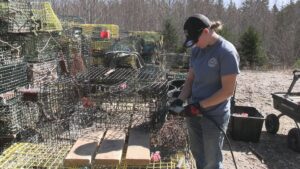
“I’ve also been talking to people about marine protected areas. They at least protect a fragment of the fish population.” He believes that Maine’s lobster fishery, with its minimum and maximum size limits as well as protection of egg-breeding females, is likely having a long-term effect on the species. “Those rules were originally designed to protect the breeding stock, but might also be creating some evolutionary changes in the species. That would be an interesting area to look into.”

Conover is one of only a few scientists in the world doing this sort of research, and the only scientist in the U.S. Perhaps his work will open the door to the evolutionary study of other species. He chose silversides because of their quick reproduction rate and relatively short life span. What’s needed now is a group of scientists willing to do the same sort of study on longer-living species. Maine’s $750 million annual commercial fishing industry cannot afford to evolve in the wrong direction.


Jeff Della Penna is a frequent contributor to Fishermen’s Voice, a monthly newspaper out of Gouldsboro. An extended version of this piece appeared in its August issue.

Bangor Metro Best Restaurants 2008

From haute cuisine to truck-stop fare, Bangor Metro readers share their preferences on where to go to satisfy any and every craving

Brew North

Artist Frank Sullivan brought his family north for a calmer existence with more time for the good things in life -- like home-brewed beer.

Dancing in Glass

Studio glass sculptor Richard Remsen takes an ancient practical art and turns it into a joyous high-temperature dance.

Fashion Funds

Creative minds in Bucksport design a runway project to support Buckport's Performing Arts Center.

Gephyrophilia

Let every woman praise the bridge that carries her.

Green Gavelers

Go Green auction nets $19K for Orono Library Foundation

Hearts of Gold

American Heart Association ball honors givers and raises $100K.