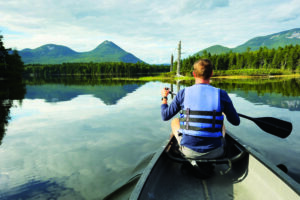
Donn Fendler, the hero of Lost on a Mountain in Maine, a book that’s been read by generations of young Mainers, became a celebrity in 1939, after more than a week lost in the wilderness in and around Baxter State Park. “Fendler Boy Found Alive in Woods Eight Days After Becoming Lost,” trumpeted the front page of The New York Times; the newspaper would then cover his reunion with his father at Eastern Maine General Hospital, his public reception back home in Rye, New York, his meeting with President Franklin Delano Roosevelt, and even his 1944 enlistment in the Navy, during World War II. Fendler would go on to spend 28 years in the Army, join Special Forces with the 101st Airborne, fight in the Korean Conflict and the Vietnam War, and retire as a lieutenant colonel in 1978.
That’s about the time he became a celebrity again, when the book was reissued and became a Maine classic, widely assigned by grade-school teachers for Maine studies. “I came back to Maine a couple of times with my brother,” he says. “The lady we rented the camp from brought me a stack of books to sign. Everyone had heard I was there. I guess these teachers meet at conventions and, jeez, it just took off.”
Now 82, Fendler and his wife of 56 years, Maryrose, still summer by the shores of Sebasticook Lake in Newport. Parents of four children and grandparents to six, they live in Clarksville, Tennessee, from October to May. But every fall he tours Maine schools, talking to rapt children about his adventure, signing books, and passing on lessons about wilderness safety and, as he says, “faith and determination.”
He receives no royalties from the book, no speaking fees for his appearances. He still sounds much like the narrator in the book (by Donn Fendler as told to Joseph B. Egan), speaking matter-of-factly and without guile.
“I answer every single letter the kids send me, handwritten and signed,” he says. “You do that. Kid’s nice enough to write to you, you ought to take the time to write back to them, and not just a stamped thing. I put each kid’s name. I say, ‘Thank you so much for your letter; it was nice of you to write.’ And then I answer their questions. I write the same thing a lot because they all ask the same questions, but I write to each one of them, and I love it.”
His survival story is familiar to most Maine residents: Twelve-year-old Donn, his father Donald, brothers Ryan and Tom, and two friends climbed Mt. Katahdin on July 17, 1939. He was separated from the party in the thick clouds near the Tableland on the Hunt Trail, and walked off the trail, down the mountain. Over the next few days he was ripped by rocks and bushes, then lost his sneakers, got eaten alive by bugs, lost his dungarees, and sliced his feet to ribbons, yet survived with the help of a “guardian angel.” Hundreds of Maine National Guardsmen, rescue personnel, and paper workers from Millinocket searched for him, and the story made national headlines on a daily basis—until he finally emerged from the woods on July 25, near Stacyville on the East Branch of the Penobscot River.
Bangor Metro spoke to Fendler at his cottage on Sebasticook, the same lake the family stayed at on that fateful day. “We always came back to this lake,” Fendler says. “And when I retired for good, I came right back here. I didn’t want to go anyplace else.”
You spent summers in Maine from 1935 to 1939. What were those summers like?
Wonderful. They were the best memories of childhood you could ever have, bar none. We would be here all summer long, then go back just before school. My father had his business [Donald Fendler was in church goods, and the family still runs CM Almy, with a factory in Pittsfield], and we would rent our home in Rye. We were a block away from the beach, right on Long Island Sound, so it was easy to rent. There was hardly anybody on this lake then, compared to what it is today. Heck, we’d do a lot of skinny-dipping in those days. You can’t now. I’d walk downtown to the baseball field. The town had a baseball team in a league, and they’d play all the surrounding towns. They all had baseball teams. I was a batboy for the team. At the end of our road was a blacksmith shop and we’d just sit in there and watch him work. It was amazing.
You also lived in Palmyra?
When my twin brother [Ryan] and I went to Maine Central Institute, my dad bought a place in Palmyra—a farm, although we never farmed it. We had that home for many years. My twin brother [now a Camden resident] lived there for 27 years.
You visit schools all over the state every fall.
We [Maryrose often travels with him] spend September and part of October going to numerous schools and libraries and a couple of museums. I do Cole Museum about every year. I do Baxter State Park every year, talk to campers up there, but primarily it’s schools. The phone calls start in August. John Thurlow has a website [www.donnfendler.com] about me, and people find me. He’s good, he thins people out a bit—because I never say no to anyone.
I get the sense you truly like visiting with kids.
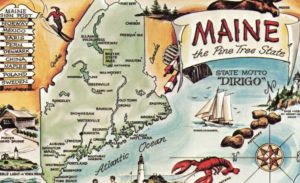
I enjoy it because we get to meet so many great young kids. We meet great teachers and we get to see a lot of neat schools, and we see a lot of Maine. Behind you, on that map, are pins of all the schools that I talk to and places where I’ve been invited. We get to visit Maine, places where a lot of Mainers don’t even go, and we love it.
What do you want them to hear from you?
I hope the message that I give sinks in. It’s really about faith and determination. That’s the whole message.
Faith is certainly a big part of the book. Does it remain a big part of your life?
Oh, yeah. I’m not overly religious and I don’t push my religion on anybody. I’m not the greatest churchgoer in the world. But I say my prayers and I faithfully believe in my God, my guardian angel, all those things I’ve been taught, you know? I’m still a pretty good person.
In the book, you have several encounters with a guardian angel, and the feeling that you are being led. Have you felt that at other times?
No. Never. But my beliefs helped me get out. I tell the kids, “You can believe this or you don’t have to believe it, but Catholics believe in guardian angels.” Out there, I’d come to the point where I’d pass out and I couldn’t get up. I just couldn’t get up. And I’d feel these hands on my shoulders. The kids, people in general, they can believe that, or they can believe it was the will to live. I tell them how tough they all are in their hearts and their minds. A lot of them say, “I’d die.” But I always say, “No, you wouldn’t die. You would get up.”
What’s it been like, doing these visits over all this time? How are the kids changing?
They’re all the same to me. I always tell them, “The girls up in Fort Kent are just as beautiful and nice as you are. And the boys are just as ugly.” And they all laugh. But really, kids are kids are kids. The cool thing is that most of the kids are getting outdoors. Most of them are campers and climbers and hikers.
A lot of kids have climbed Mt. Katahdin. So they know what the woods are all about. When you try to tell them about the woods and survival, some of them send you a thank-you note, for telling them about sitting down in one place if you get separated. But these days, a lot of them say, “Well, you should’ve added” this or that. One kid said to bring a flare gun, and half the kids in the class jumped all over him: “No, you’ll set the woods on fire!” They know.
Did you ever imagine you’d still be out there, doing these speeches, almost 70 years after you got lost?
It never ceases to amaze me why this thing continues on and why it got so big. It’s been explained to me, but I can’t believe it. Here, this dumb kid gets lost out in the woods, he wanders around out there, and he comes out of it by the grace of God. But what’s such a big deal? Apparently in Maine, it was something unbelievable that I could’ve survived. Maybe it’s because there wasn’t much news in those days. People remember me.
When did you realize it was a big deal, after you got lost?
I was in [Eastern Maine] hospital and they gave me all these stories. I was on the front page of The New York Times. I was in Life magazine. I got a medal from the president. Meeting Franklin Roosevelt was probably the greatest experience of my life. What a man. He made you feel so much at home. But I also met people like [explorer] Lowell Thomas, and I was an honorary member of the Adventurers Club, which had people like Admiral Byrd. That was incredible.
How did the book come about?
It’s hard for me to say. I was a 12-year-old boy and not that interested in a book. I’m guessing my father ran into somebody that knew this Dr. Joseph Egan, from Boston, and he wrote children’s books. He and my dad got together and they thought that the story would be meaningful to young people, about determination and survival, determination and faith.
How did you collaborate with Dr. Egan?
I went to his camp on Cape Cod with my twin brother, in August, right after I came out. He asked questions, and I’d answer. You’ll see in there that certain things happened on certain days. It may not have happened then. I lost track of time. But we wanted to show, or have the kids read, that these things happened. I saw the bears, I heard the airplane. I found these cabins. My dad said to me before I left, “Don’t try to embellish it, don’t try to add things that didn’t happen. If you don’t know or remember, tell him.” And Dr. Egan just said, “Tell me what you saw, or what you heard.” The book was published in September, and I’ve only seen two originals. They’re rare. I don’t even have one.
Lost on a Mountain in Maine wasn’t that well-known at the time, was it?
The book didn’t go. It sold for $1, and my father had a [financial] piece of it. But it was during the war years and my dad developed the kits the chaplains carried during World War II, and the book didn’t go and it just faded. Then, a guy in Somers-worth, New Hampshire, had a publishing house, and for some reason, he put my book out. He passed away, and prior to that, he sold it to Picton Press out of Camden. The book took off when they put it in Maine studies, somewhere in the 1970s. The book just took off. The copyright had long passed and it was public domain. I don’t get any royalties, never got any money from the book.
Will there ever be a movie?
There may be, but I can’t talk about it right now. We’re waiting. But there could be. It would just be for the state.
Seems like you pop back into the news every so often, like when Governor Baldacci gave you a lifetime fishing license in 2007.
There’s my favorite picture up there, when I got that fishing license. That story wound up on BBC, in Europe. I couldn’t believe it. I happened to mention it to [state Department of Conservation commissioner] Pat McGowan. I’ve known him for years, and I was kidding him. I said, “You people owe me a fishing license. Governor Barrows [Maine governor 1937–1941] promised me a lifetime fishing license and he never sent it.” Next thing I know, I’m meeting Governor Baldacci and getting my license. The governor was so great. I don’t know anything about politics, but I think he’s a great people’s man. And his wife, she’s wonderful.
You do a lot of fishing?
I fished yesterday, with a retired colonel friend of mine. I fish every chance I get. My brothers and I like small ponds or rivers. I go up to the East Branch of the Penobscot, up near Eddington, right off of Route 187, and it’s nice. It’s easy to get into and we always get plenty of bass.
And you swim in the mornings?
I work out three days a week in Pittsfield, lifting weights. I don’t expect to be Arnold Schwarzenegger, but I work out about an hour and 45 minutes. And then three days, I swim. There’s a doctor in town that allows me to swim in his pool, because it’s hard for me to do lap swimming in the lake. So normally I try to work out six days a week.
You must be pretty fit for an 82-year-old.
I don’t know. I get out of breath walking down to that boat. I smoked 50-something years, until I had a heart attack [in 1996]. And from the day that arm tingled and the chest pain, I haven’t smoked. But as far as being strong and in shape, my heart’s good. That’s the main thing. But I have the usual old folks problems. You’re so thrilled when your feet hit the floor in the morning. You get up, you’re just thrilled to death.


Email this page
Print this page
del.icio.us
digg